
Perhaps one of the most significant promises given to us by Christ is what is found in John 8:32: “You shall know the truth and the truth shall set you free.” This, of course, is granted to those that “continue in [His] words,” but such a promise gives valuable insight into the one who promises.
Simply put, a pursuit of Christ is a pursuit of truth.
“Truth in what areas?” you may ask. I am glad you might. All areas. The promise of truth permeates all areas of academic study, with the continued caveat to remain in His words.

This pursuit of truth becomes especially relevant within historical research. Stephen Leston, in his book The Bible in World History, asserts that “only a Christian view of history truly addresses the issues that drive mankind and thus only a Christian worldview can give us what we need to understand the world around us.” Furthermore, the Christian historian faces the unique challenge of seeing the world through that lens, and yet must not read theology into historical environments where it does not belong.
Take, for example, the “James Ossuary” seen below.

This artifact, introduced to the world in 2001, was said to have contained the remains of James, the half-brother of Jesus. It caused quite a stir, and it was right at home with the thousands of other religious relics, but the only problem was that it wasn’t real. Sure, the coffin had been made near the first century A.D., but the inscription attaching it to James…. was fraudulent. It made more sense to bend history around religion than to utilize the core of the Christian faith to search out and establish truth, even if it underwhelms at times. No sound historian can fall into that trap.
A Christian friend of mine and I were talking just the other day about our differing opinions of the United States of America. I listened as he adamantly attested to his point of view, but upon asking for historical specifics I found that he could deliver none. He had firmly established a worldview that had very little basis in historical fact and seemed unbothered, and at times downright perturbed, when historical data was provided that challenged him. Unfortunately, this is common among American Christians. A study done by the Pew Researcher showed that in America, Christians are less educated than other religious minorities. How can this be?
It is not possible that one would point to Christ and yet defend willful ignorance. If Christ has promised a truth that permeates all areas, certainly we ought to pursue it, in Him. The essence of all science, mathematics, philosophy, and logic tells of Him. Clement of Alexandria testified that science and philosophy were the “schoolmasters” used to bring the Gentiles to a greater understanding of God.
The argument often levied against these types of pursuits of truth is one of caution against the loss of focus on the object of our faith, that is Jesus the Christ. This is folly in that it ignores the premise, that all truth belongs to Him. Where we seek truth, we find Him. Where we seek Him, we find truth. As Jesus, Himself told us: “I am THE way, THE truth, and THE life.”
In Rome, there was once a manhole cover made in the image of a face. Much later, after Rome had faded away this manhole cover began to be called the “Mouth of Truth,” as it was believed that if you told a lie and then placed your hand in the mouth it would bite you. Oh, if only it were that simple to see where the stories told veer from the truth…
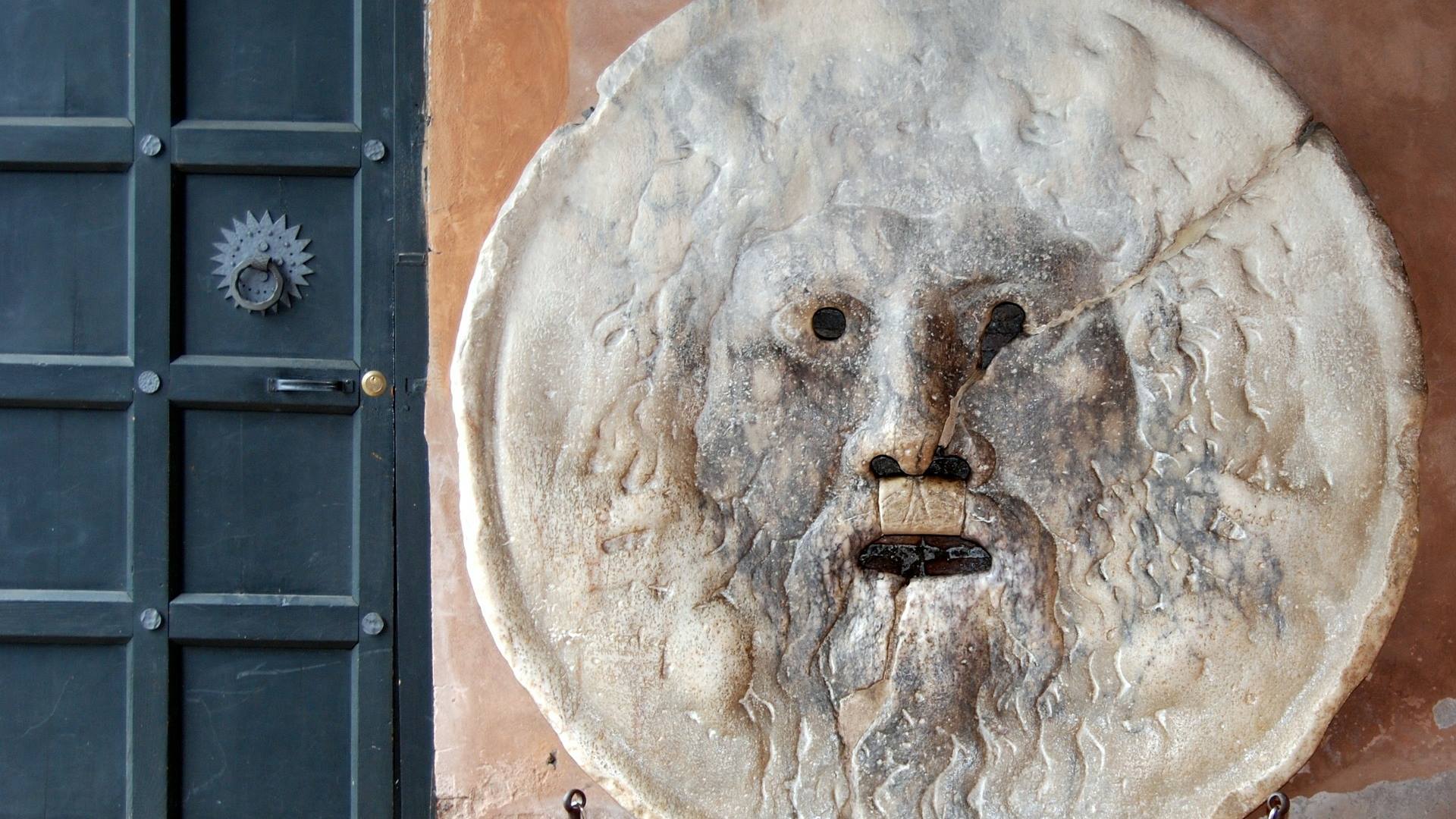
My fellow Christian historian, would the “Mouth of Truth” bite your hand?
-GLS
 Bearlee Afloat